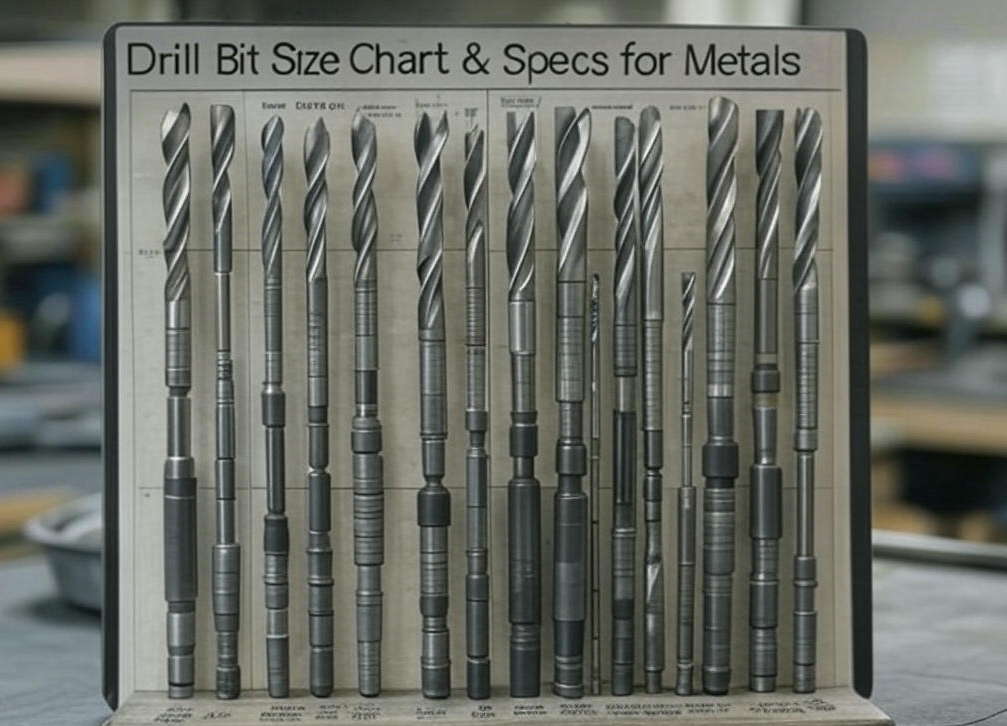
Drill Bit Size Chart and Specs for Metals: Your Ultimate Guide

Drill Bit Size Chart and Specs for Metals: Your Ultimate Guide

Drilling into metals requires precision, patience, and the right tools. Whether you’re working on a DIY project or a professional machining job, understanding a drill bit size chart and the specifications tailored for metals can make all the difference. From steel to aluminum to titanium, each metal has unique demands, and picking the wrong drill bit size or type can lead to cracked bits, ruined materials, or sloppy results. In this comprehensive guide, we’ll explore drill bit sizes, key specifications, and expert tips for metal drilling. Let’s get drilling!

Why Drill Bit Sizes Are Critical for Metalworking

Unlike softer materials like wood or plastic, metals are dense and resistant. A misstep in choosing your drill bit size can mean the difference between a clean, functional hole and a costly mistake. A drill bit size chart is your essential companion, helping you match bits to your project’s needs—whether you’re prepping for screws, tapping threads, or creating custom fittings. With metals, there’s no room for guesswork; precision starts with the right size and specs.

The size of your drill bit directly impacts the hole’s diameter, which must align with fasteners, bolts, or other hardware. Too small, and your screw won’t fit; too large, and your connection weakens. That’s why understanding the sizing systems and specifications for metal drilling is a must for anyone serious about their craft.

Breaking Down Drill Bit Size Charts

Drill bits come in three primary sizing conventions, each with its own use case. Here’s a deep dive into each:

  1. Fractional Sizes (Inches)
    Measured in fractions of an inch, these range from tiny 1/64” (0.0156”) to 1” or more. Common sizes include:
    • 1/16” (0.0625”)
    • 1/8” (0.125”)
    • 1/4” (0.25”)
      Fractional bits are a staple in North American workshops and excel in general-purpose metal drilling tasks like creating holes for bolts or screws.
  2. Numbered Sizes (Wire Gauge)
    Known as wire gauge sizes, these range from #1 (0.228”) down to #80 (0.0135”). The higher the number, the smaller the diameter. For example:
    • #30 = 0.1285”
    • #52 = 0.0635”
      These are perfect for precision work, such as pilot holes in thin steel or aluminum sheets.
  3. Metric Sizes (Millimeters)
    Measured in millimeters, metric bits align with international standards. Examples include:
    • 1mm (0.0394”)
    • 3mm (0.1181”)
    • 10mm (0.3937”)
      Metric sizes are increasingly popular in global industries and pair well with metric fasteners.

Here’s a handy drill bit size chart for quick reference:

Pro Tip: Print out a laminated drill bit size chart or save it digitally—having it on hand saves time and guesswork in the shop!

Essential Drill Bit Specifications for Metals

Choosing the right size is only half the battle. The drill bit specs for metals determine how well your bit performs and lasts. Here’s what to consider:

  1. Material
    • High-Speed Steel (HSS): The workhorse of drill bits, HSS is affordable and effective for softer metals like aluminum, copper, and mild steel. It’s versatile but wears faster on tougher materials.
    • Cobalt (HSS-Co): Alloyed with cobalt (usually 5-8%), these bits are built for harder metals like stainless steel and titanium. They withstand high heat and resist dulling.
    • Carbide: The premium option, carbide bits excel with abrasive metals like cast iron or exotic alloys. They’re costly but offer unmatched durability.
  2. Coating
    • Black Oxide: Reduces friction and protects against rust—ideal for everyday metal drilling on steel or brass.
    • Titanium Nitride (TiN): A gold-colored coating that boosts hardness and heat resistance, perfect for prolonged use on tough metals.
    • Titanium Aluminum Nitride (TiAlN): An advanced coating for extreme conditions, like drilling high-alloy steels.
    • Uncoated: Suitable for soft metals like aluminum but less effective on steel due to faster wear.
  3. Point Angle
    • 118°: The standard angle for softer metals. It’s easier to start but can “walk” on harder surfaces.
    • 135°: Designed for harder metals like stainless steel, this sharper angle is self-centering, reducing slippage and improving accuracy.
  4. Shank Type
    • Straight Shank: Fits most standard drill chucks and works well for smaller bits.
    • Reduced Shank: Allows larger-diameter bits (e.g., 1/2”) to fit smaller chucks (e.g., 3/8”). Always check your drill’s capacity!
    • Tapered Shank: Common in industrial settings for heavy-duty drills.
  5. Flute Design
    • Twist Flutes: The most common for metals, with deep grooves to eject chips and prevent clogging.
    • Parabolic Flutes: Deeper and wider, ideal for drilling deep holes in thick metal plates.
    • Straight Flutes: Rare for metals but useful for brittle materials like cast iron.

Drill Bit Size Chart for Tapping Metals

If you’re threading holes in metal, your drill bit size must match the tap. Here’s a detailed drill bit size chart for tapping common bolt sizes:

Always consult a full tap chart for specific thread pitches and tolerances—accuracy is key!

Expert Tips for Drilling Metals Like a Pro

To maximize your success with a drill bit size chart and the right specs, follow these proven techniques:

  1. Match Bit to Metal
    • Aluminum: HSS with a 118° point angle.
    • Stainless Steel: Cobalt with a 135° angle and TiN coating.
    • Titanium: Carbide or cobalt with cutting oil.
    • Cast Iron: Carbide with straight flutes for brittle chips.
  2. Control Speed and Feed Rate
    Harder metals require slower speeds (lower RPMs) and steady pressure. For example:
    • Aluminum: 2000-3000 RPM
    • Steel: 500-1000 RPM
    • Stainless: 200-500 RPM
      Check your drill’s manual or an RPM chart for specifics.
  3. Use Lubrication
    Cutting oil or coolant reduces friction, dissipates heat, and extends bit life. Apply generously when drilling steel, stainless, or titanium—aluminum often needs less.
  4. Drill Pilot Holes
    For holes larger than 1/4”, start with a smaller bit (e.g., 1/8”) to guide the larger bit. This prevents wandering and ensures precision.
  5. Sharpen Regularly
    Dull bits overheat and damage metal. Use a bench grinder or drill sharpener to maintain edges, especially with HSS bits.
  6. Secure Your Workpiece
    Clamp metal firmly to avoid vibration or movement—loose metal can snap bits or ruin holes.

Choosing the Best Drill Bit for Your Metal Project

With so many options, how do you pick? Here’s a quick decision guide:

Common Mistakes to Avoid

Conclusion: Master Metal Drilling with Confidence

A drill bit size chart and the right specifications are your foundation for successful metal drilling. Whether you’re tapping threads in steel, punching holes in aluminum, or tackling titanium, this guide equips you with the knowledge to choose the perfect bit. Pair that with proper technique—slow speeds, lubrication, and secure clamping—and you’ll drill like a pro every time.

PartzPro Frequently Asked Questions

The "Open-Book" Business Model

Q: Why is there a factory invoice in the box?
That is your Commercial Import Invoice. Because we ship Factory Direct to your door, international customs requires an invoice that travels with the package.
  • Transparency & Compliance: This invoice lists the origin factory (showing you exactly who made your parts) and declares the exact value you paid at checkout.
  • Why it matches your payment: We ensure the commercial invoice matches your transaction value so that Customs calculates your duties correctly and legally, preventing delays or penalties at the border.
Q: Why don't you offer Instant Quotes?
Because "Instant" usually means "Inaccurate." Competitors use algorithms to guess the price based on geometry averages. This often leads to:
  • The "Bait & Switch": They quote low instantly, then email you 24 hours later to raise the price once a human actually looks at it.
  • The "Risk Buffer": They inflate the price by 30% just to cover the errors their algorithm makes.
We measure twice, cut once. We have the factory validate the CAM strategy before we give you a price. You wait a few hours, but the price you get is the price you pay—guaranteed. No surprises.
Q: If I have the factory’s info, why shouldn't I just go direct next time?
First, strictly speaking, you cannot. To protect our platform, our Terms of Use include a Non-Circumvention clause that prohibits direct transactions with our suppliers for 24 months.

But practically, clients stay for the "US Shield." When you order through PartzPro, your money is held in US-based Escrow. We handle the legal leverage, language barriers, and financial security. If you go direct, you lose that protection and have zero recourse if something goes wrong.
Q: What exactly does your Service Fee cover?
Your fee covers Financial Security (Escrow), Vendor Vetting, AI Engineering Analysis, and Project Management. We act as your US-based legal firewall. We find the best factories, negotiate the rates, and hold the money until the job is done right.

Logistics, Customs & AI Technology

Q: Who handles the HTS Codes and Customs paperwork?
Our AI does the heavy lifting; you just confirm the release. We don't leave you guessing on complex government tariffs.
  • Heavy AI Analysis: Our proprietary AI Assistant performs a 40-point analysis of your part's geometry and material. It automatically searches the official US Government HTS database to generate a precise HTS Code Breakdown for your specific parts.
  • The Process: This data is provided to the carrier (DHL/FedEx/UPS). When the broker contacts you, the classification is already estimated—you simply confirm it to release the shipment.
Q: Who pays the duties?
You do—which saves you money. Because we ship DAP (Delivered at Place), you pay the exact duties owed to the government based on the AI-generated HTS code.
  • Why this is better: Competitors who offer "Free Shipping/DDP" often inflate the price to cover the worst-case tariff scenario. By paying the actual duties yourself, you ensure you are never overcharged for import taxes.
Q: How fast is shipping?
Since we skip the "Middleman Warehouse," our standard international shipping is extremely fast (typically 3–5 days transit). Your parts fly directly from the machine shop to your desk.

Quality Assurance & Liability

Q: Competitors inspect parts at a US warehouse before shipping. Why don't you?
Because "double handling" kills speed and adds unnecessary cost. We operate on a "Dock-to-Stock" model. The factory performs the rigorous QC, and parts ship directly to you.

We treat you like a professional: we know you will verify the fit and function of your parts upon arrival. By removing the redundant middleman inspection, we save you 30% on cost and 3–5 days on lead time.
Q: What happens if the parts arrive out of spec?
You are protected by the PartzPro Escrow Guarantee. Because we hold the funds, the factory does not get paid until you verify the order.

The Process: You have a 3-Day Inspection Window upon delivery to verify fit and function. If parts are non-conforming, simply upload a photo and inspection report within that window. We will either force an immediate priority remake at the factory’s expense or issue a refund.

*Bulk Order Extension: For large volume orders, this inspection window can be extended. To request an extension, simply reply to your automatic invoice email.
Q: Does your AI just check for geometry errors?
No. Our AI Cost-Driver Audit goes beyond simple DFM (Design for Manufacturing). It helps you perform Value Engineering by highlighting features that are disproportionately expensive (e.g., deep pockets, tight radii, non-standard threads). We show you the cost drivers so you can engineer the price down before you order.

Payments & Corporate Orders

Q: We are a company, not a hobbyist. Can we pay via Purchase Order (PO)?
Yes. We specialize in serving agile engineering departments and mid-sized manufacturing firms.
  • How to order with a PO: You can select "Pay via PO / Wire" at checkout or email our sales team directly with your PO attached. We will verify your company details and send a payment link or wire instructions immediately so production isn't delayed.
Q: Do you offer Net-30 Terms?
We offer terms to qualified business partners after an initial credit review. Please contact our sales team to set up your corporate account. For new customers, we recommend using our PO-to-Wire workflow for the fastest start.

Disclaimer: Information for users reference only on our blog and website
Please be advised that the content presented on our blog and throughout our website is intended strictly for informational purposes. It is designed to serve as a preliminary guide and reference point for our customers embarking on their projects. We endeavor to provide insightful and useful information, but it is imperative for each individual and organization to undertake their own comprehensive research and assessment before making any decisions related to their designs or component usage.Our blog and website content should not be considered as a replacement for specialized advice suited to your unique requirements. For more detailed terms and conditions, kindly refer to our Terms of use. The responsibility for the application of any information obtained from our blog or website in your designs, applications, or parts usage, rests solely with you, the reader or user. Our goal is to inform, advise, and inspire; however, the ultimate application and use of this information is under your discretion and liability.